I have been birding for close to 16 years now. In that period of time, I have had a few Singapore first bird records; that is, being the first person to discover that particular bird species in Singapore. It’s one of the more sought-after achievements in birding, for it’s not every day you can come across a rare bird, much less be the first person ever to see the species in the country. So, naturally, I have been asked once in a while, “How many Singapore first bird records do you have?”
I can’t answer in a straightforward manner with a single number. Instead, let me tell you the individual stories behind each discovery and then give you my thoughts about them later.
1. Lesser Black-backed Gull / Taimyr Gull – Singapore Strait (20 November 2011)
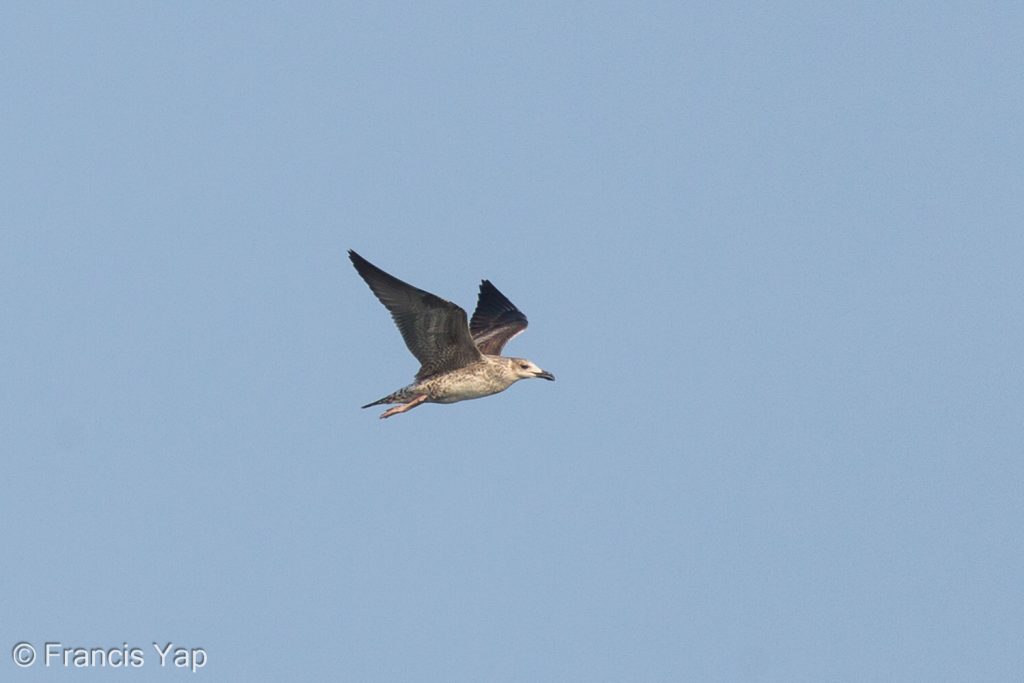
Lesser Black-backed Gull at Singapore Strait
I was invited to join a pelagic boat trip with members of the Nature Society (Singapore) (NSS) Bird Group for the first time on 20 November 2011. At around 8:23 am, a medium-sized bird flew from a west to east direction, passing by our boat. I was positioned on the upper deck of the boat and saw it, getting a series of shots. Down below, the other birders also witnessed it, and another photographer, Lee Tiah Khee, photographed that bird as well. It looked like a gull, but at that time, I had no idea where to begin and deferred the ID to the other, more experienced birders. They all settled on it being a juvenile Larus gull type, but the actual ID was not easy until, upon advice from Dave Bakewell, I sent an email to Nials Moore, who is based in South Korea. Here is his reply via a blog post here (scroll down a bit).
The sighting and record was then accepted by the NSS Bird Group Records Committee (NSSBGRC) soon after, and the species was included into the new checklist. Yay! So what’s the problem? The inclusion didn’t last. A few years later, the committee changed its mind and removed the bird from the list. Apparently the exact location of the sighting became an issue as they relooked at some of the older pelagic trip records. I managed to retrieve the data from a GPS logger I had running then, and the location of the discovery is shown here.
For their part, the Bird Society of Singapore’s Records Committee (BirdSoc RC) decided to place the record on their Annex A instead of in Category A. This simply means it’s not in their main Singapore checklist either.
2. Red-footed Booby – Singapore Strait (13 May 2012)
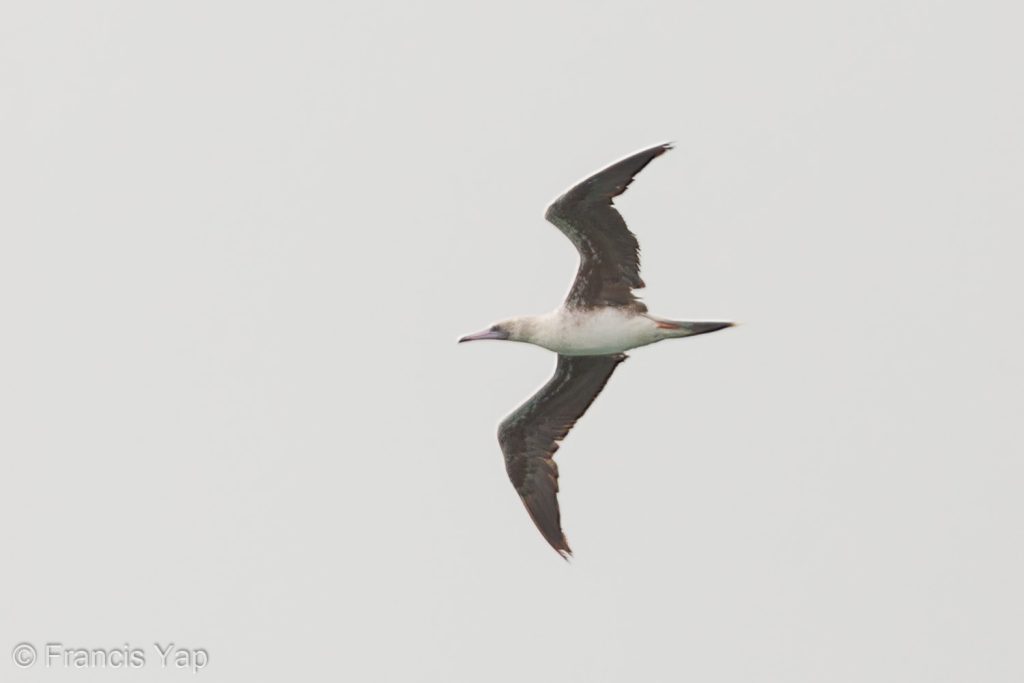
Red-footed Booby at Singapore Strait
Another pelagic trip organised by NSS, and this time I moved to the front of the boat together with Lim Kim Seng. With a clear wide view of the sea ahead, we soon saw a large bird flying near a ship at around 7:06 am. I remember shouting “Bird!” to alert the rest who were seated at the back of the boat. They largely managed to see the bird, but our front views were the first and the best. The bird was following a ship named “Jin Hai Yu”. It was headed towards the Changi side while we were closer to the Pengerang, Johor side. Our exact observation location, based on my GPS logger, was here.
I don’t recall exactly whether the ID of the booby was confirmed immediately by others. I have a hazy notion that we thought it was a booby, pending my photos for an exact ID. In the end, back at home with a field guide in hand and the photo on the computer screen, it was obvious to me that it was a juvenile Red-footed Booby.
How did this sighting rate? Well, at that time, the record was considered legitimate, and we happily filed it under our respective national first achievements. However…
About a year later, Chan Yoke Meng and Melinda Chan realised a bird they had photographed on 9 February 2011 at the former Muslim Cemetery in Lim Chu Kang turned out also to be a Red-footed Booby, hence predating our sighting by a year. Their write-up can be found here.
3. Black-and-white Bulbul – Jelutong Tower (29 May 2012)
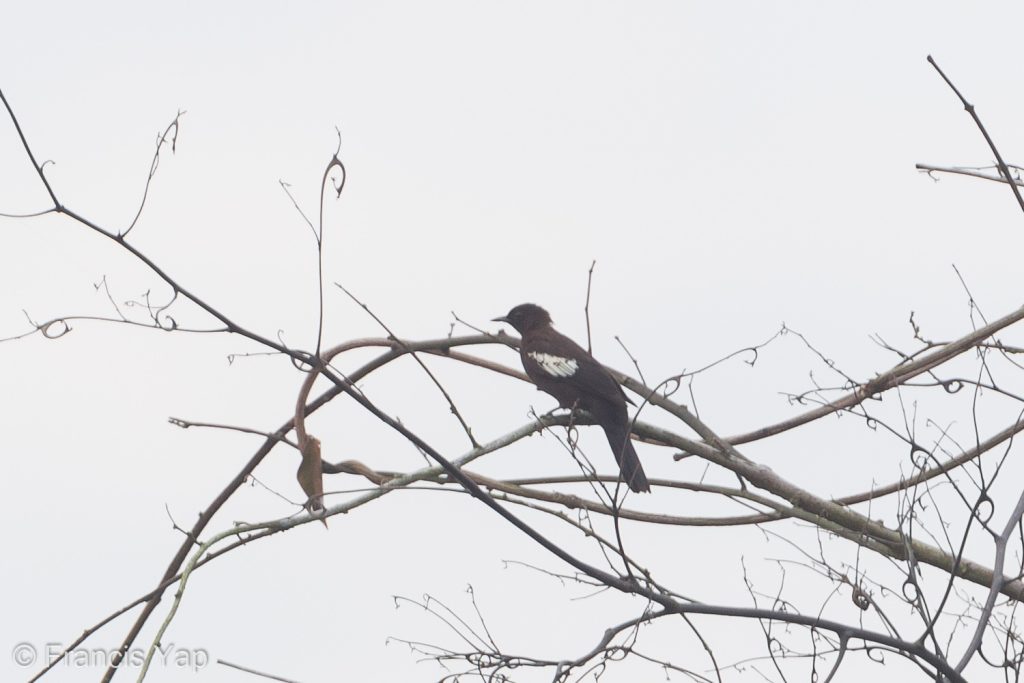
Black-and-white Bulbul at Jelutong Tower
A routine trip to Jelutong Tower led to the discovery of this bulbul. I have written about the circumstances of this discovery to the wildbirdSingapore Yahoo Group. You can have a read below. To summarise, I was observing a Green Leafbird perched on the bare branches at the canopy of a distant tree. It flew off, and another black bird flew in and perched on the same branch. I initially thought it was a Square-tailed Drongo-Cuckoo due to its size and small bill (hence ruling out the Crow-billed Drongo). I noticed that there was a white patch on the wing, which made me doubt the ID. I was the only observer at the tower and I don’t even recall informing anyone about it. Unfortunately, my WhatsApp message archive only extends to 2013. Back home, I processed the photo and asked around, hoping for more experienced birders to help identify it; the reply was that I had photographed a Black-and-white Bulbul, a rare bird even in Malaysia and known to be a wanderer.
Were there any controversies regarding the sighting? Firstly, there is an earlier observation made on eBird (that was for an observation on 9 October 2010 but submitted 12 years later in 2022). Secondly, in a personal conversation with the late Subaraj, he mentioned seeing this species a few times in the Central Catchment area. However, none of these observations by either party were submitted for further scrutiny and, as things stand, my record remains the first confirmed one.
Email to wildbirdSingapore Yahoo Group: 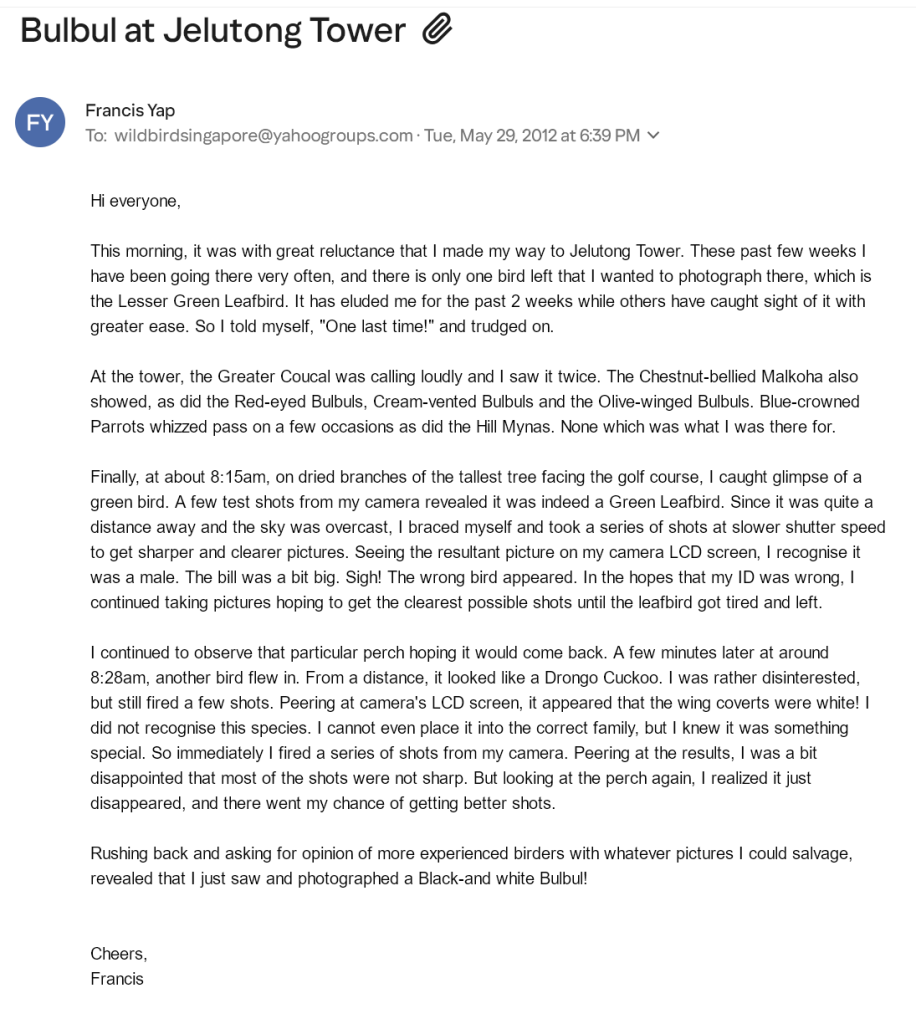
4. Shikra – Changi Reclaimed Land (8 November 2012)
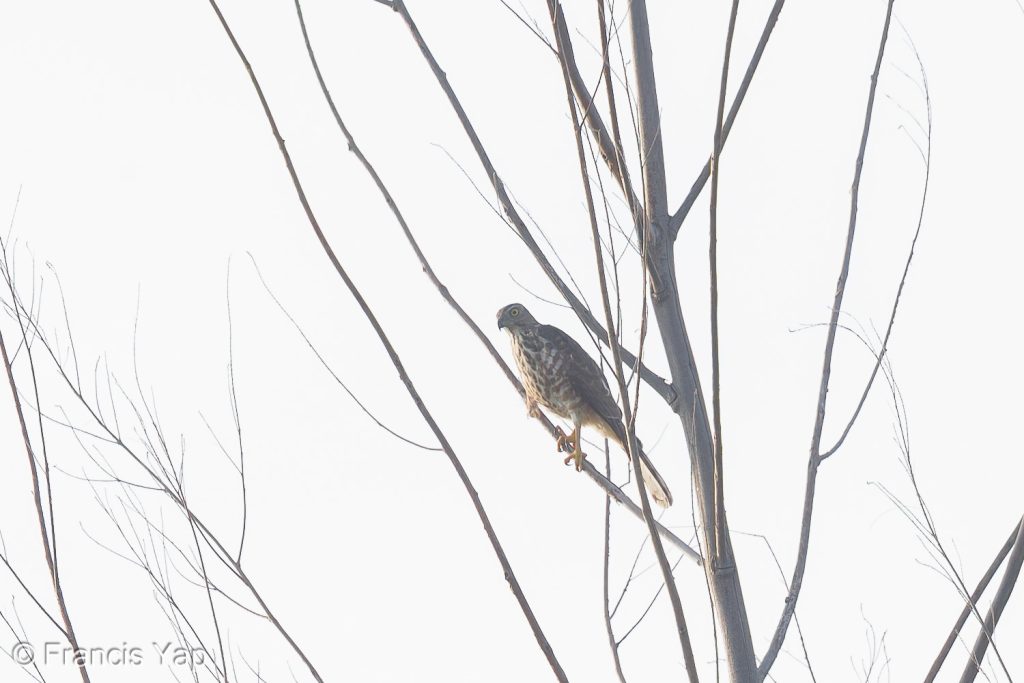
Shikra at Changi Reclaimed Land
I have written about this in a recent blog post here. In summary, I saw a sparrowhawk while on a birding trip alone at what is now Changi Airport Terminal 5, but in the past was newly reclaimed land that was left temporarily fallow. The bird was backlit, and the resulting views and photos were not ideal. When I had a chance to process the photos after the trip, I sensed it was something out of the ordinary. Two attempts to ask for help drew answers that were incorrect. Finally, in 2021, re-examining my photo archive, I came across these photos and, at that moment, came to the self-realisation that I had managed to photograph a Shikra all those years ago.
5. Black-winged Flycatcher-shrike – Jelutong Tower (23 August 2013)
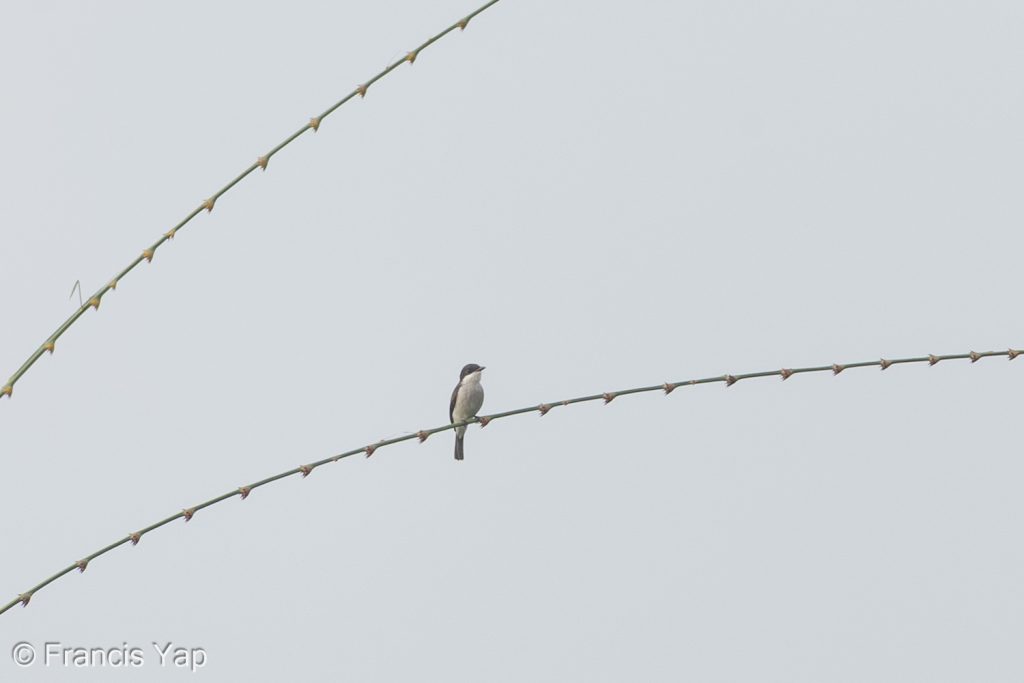
Black-winged Flycatcher-shrike at Jelutong Tower
On 11 February 2013, Chan Tsan Tsai and Geoff Lim encountered this species and submitted the record and photographs to NSSBGRC. Six months passed and there was no indication of it being included in the checklist. On 23 August 2013, I encountered presumably the same bird, photographed it, and submitted it to the Records Committee too. Two years later, in 2015, both our records were accepted and the bird was included in the NSS checklist. In this instance, there is little doubt that the earlier sighting was the national first and mine was the second. However, at the time, my record was more well-known; hence, this is a clarification about the sequence of events.
6. Sakhalin Leaf Warbler – Dairy Farm Nature Park (5 Mar 2014)
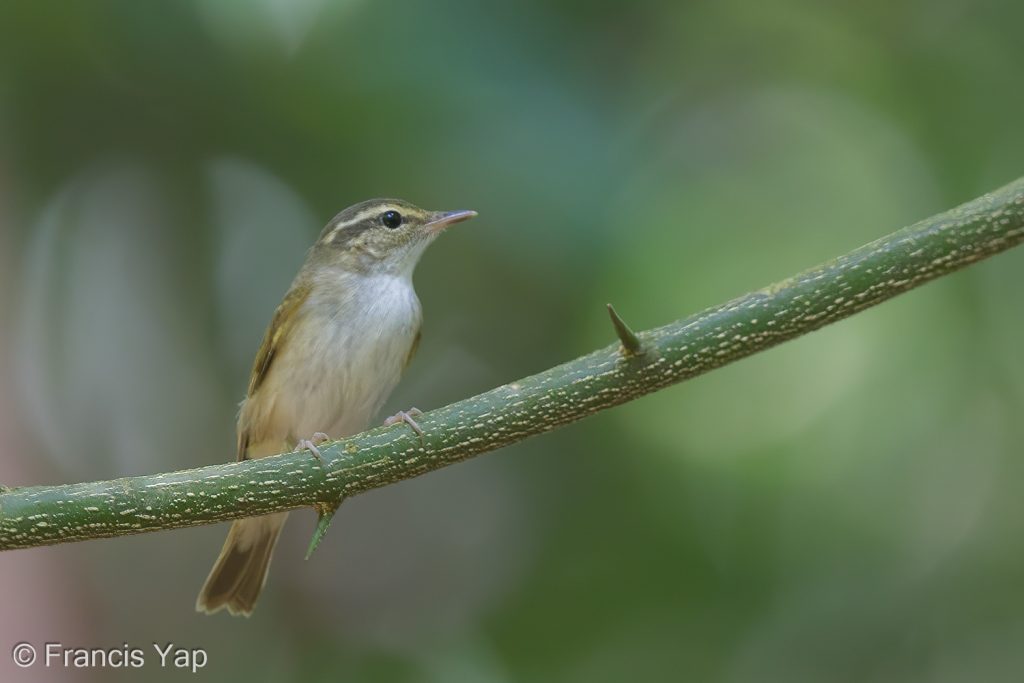
Sakhalin Leaf Warbler at Dairy Farm Nature Park
On 15 December 2013, an unusual warbler was observed by Lim Kim Keang on the trail leading from Dairy Farm Nature Park to the Bukit Timah summit. Without a good view and actual photos, the bird remained unidentified until the new year came; the first photographic evidence and sound recording ruled out the Dusky Warbler and pointed towards the Pale-legged Leaf Warbler, and there were at least two birds present.
This would have been the second record for this bird species, as there was an earlier record at Lower Peirce in 2009. Here is a copy of that record submission. This particular record was accepted and subsequently the Pale-legged Leaf Warbler was included in our checklist. I do not know how the actual deliberation went, or how the similar-looking and calling Sakhalin Leaf Warbler was excluded. Perhaps it was because it was conventional wisdom back then that there had never been a Sakhalin Leaf Warbler found in the Thai-Malay Peninsula.
Back to the birds at Dairy Farm. There was a big interest in photographing the birds when the news came out, and some minor discussion on how to actually separate the Pale-legged Leaf Warbler from the Sakhalin Leaf Warbler in the field; but like many mega-finds, interest simply moved elsewhere and the birds were generally accepted as Pale-legged Leaf Warblers. Other mega-birds, like the first Band-bellied Crake for Singapore, occupied the minds of most birders instead.
In the meantime, I had purchased an app called AudioMemos to start recording bird calls. I had thought that ever since the Arctic Warbler complex was split, there was a necessity to record bird calls for documentation as well as ID purposes. For the next three months, I made it a point to periodically climb the trail from Dairy Farm to the summit and record the repetitive high-pitched calls of the “Pale-legged Leaf Warblers”, as well as the birds up on the summit, especially the Yellow-browed Warbler which I had recently ticked. On 5 March, during one of these trips up the hill, I heard and immediately recorded what sounded very different from the normal call. I have provided a copy of the recording below:
It was an incomplete song, but not at all like the song of the Pale-legged Warbler; instead, it was very similar to the Sakhalin Leaf Warbler. I realised there and then that we had been mis-identifying the birds this while. The warblers were Sakhalin Leaf Warblers, not Pale-legged Leaf Warblers. A paper was soon published in the BirdingAsia journal about this discovery. A copy can be read here.
Seeing through the lens of a birder in 2026, it seems silly that we could have had trouble differentiating these two species, as their calls alone should have been enough to separate them. The Pale-legged Leaf Warbler’s call has a measurably higher pitch than that of the Sakhalin Leaf Warbler. However, that misses the fact that the main paper describing this pitch difference as being diagnostic was only published in 2017 and was partly based on our analysis and data gathered back in 2014. Credit goes to Dr Yong Ding Li and Assoc Prof Frank Rheindt for doing the initial sound analysis that led to this conclusion.
7. Bulwer’s Petrel – Singapore Strait (12 Nov 2016)
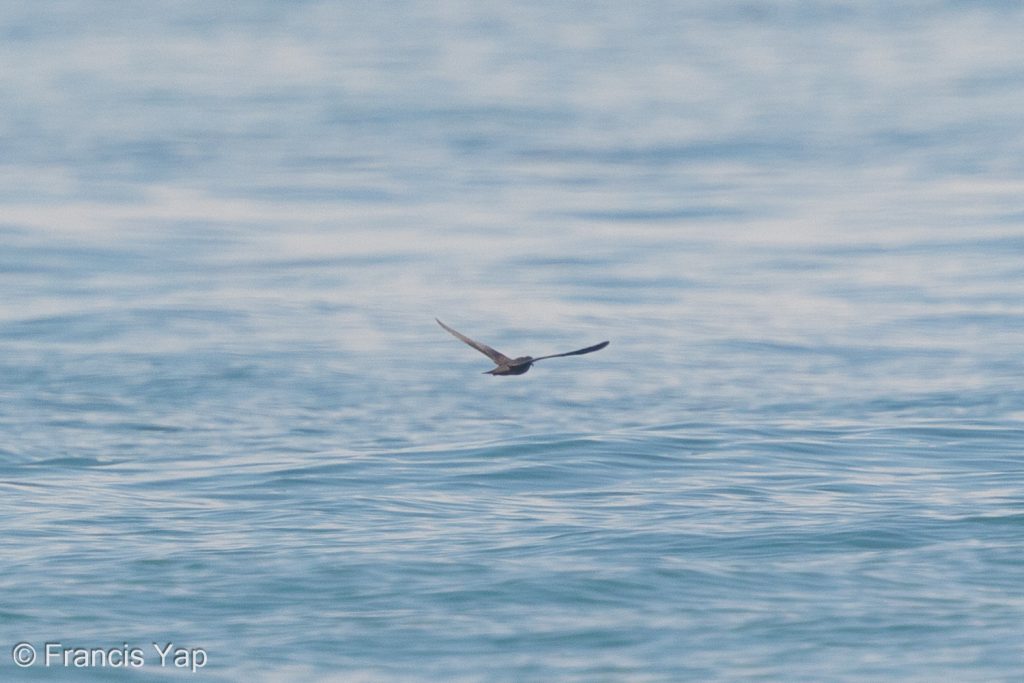
Bulwer’s Petrel at Singapore Strait
I joined a pelagic trip along the Singapore Strait organised by Adrian Silas Tay on 12 November 2016. At around noontime (12:02 pm), at this location along the Singapore Strait, I spotted a blackish bird flying low on the water and quickly informed Lau Jiasheng, who was standing next to me on the boat. We managed to track what looked like a large storm petrel but gliding more like a shearwater. The rest of the birders heard our communication and joined in tracking and photographing the bird. Unfortunately for me, I was using my secondary camera, the Canon EOS 7D Mark II, and was not used to the autofocus system; as such, I only had one in-focus shot as it flew away. Thankfully, the rest managed to get better photos. On the boat after the event, our speculation was that it was a Bulwer’s Petrel. The identification proved straighforward when our respective photos were processed and passed around to the seabird experts. There were to be two other sightings of this species around the same area in the following months (29 April 2017 and 6 May 2017 respectively), believed to be the same bird.
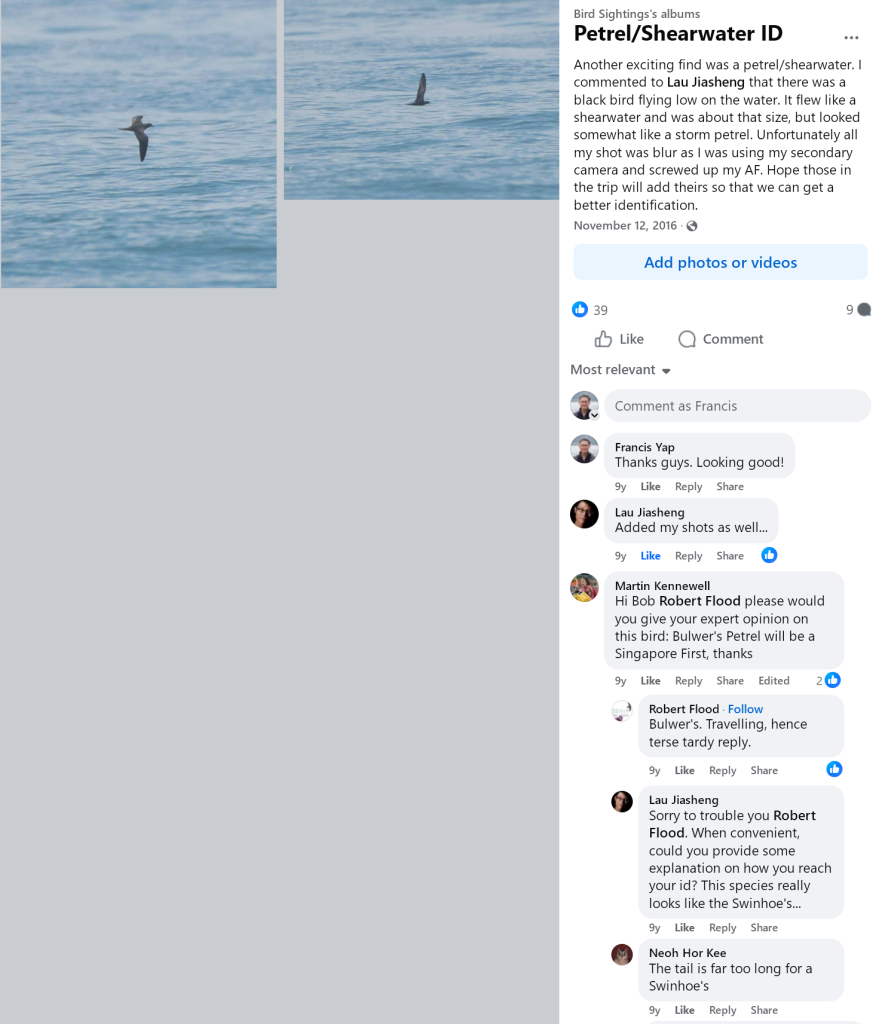
8. Wilson’s Storm Petrel – Singapore Strait (12 May 2018)
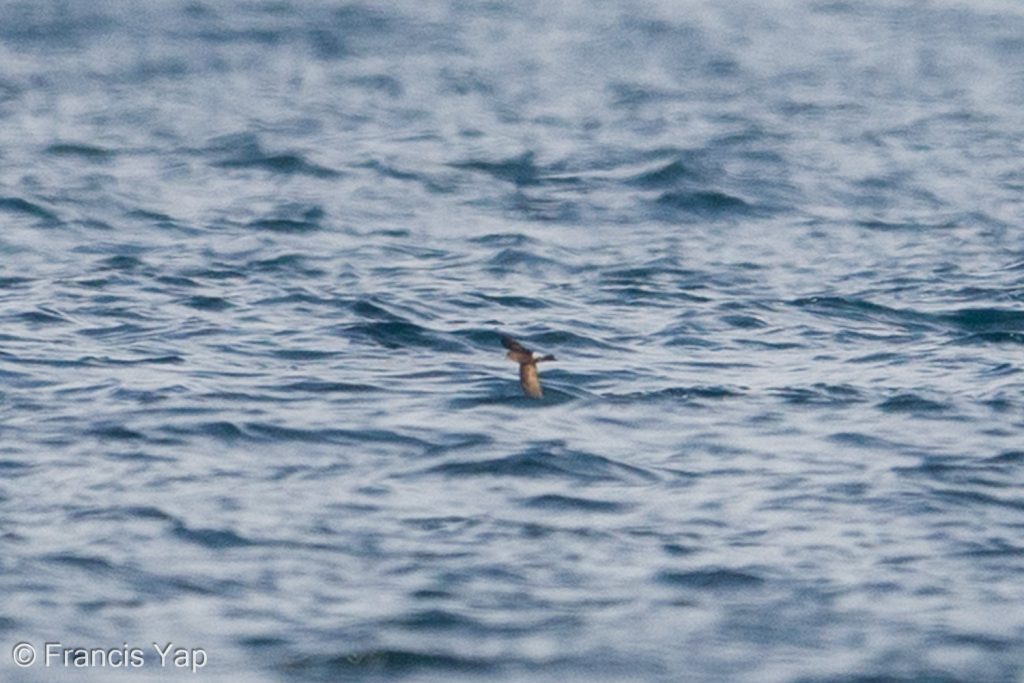
Wilson’s Storm Petrel at Singapore Strait
I joined a pelagic boat trip organised by Martin Kennewell on 12 May 2018. At around 7:58 am, I saw Martin Kennewell and Richard Carden looking intently at a distant bird and decided to join in. I really had trouble finding the bird due to its distance; it looked like a tiny speck on the viewfinder, and it didn’t help that we were on a boat that was bobbing up and down with the waves. I had an equally difficult time trying to get the camera to focus on said bird. In the meantime, both Martin and Richard had already nailed it as a storm petrel and either both or one of them mentioned Wilson’s Storm Petrel as they saw flashes of white on the rump. I was too busy trying to lock on to the bird to pay much attention to their dialogue. In the end, I had only two very poor-quality and distant photos, but crucially, it did look like a storm petrel with a white rump.
In all likelihood, what we saw and photographed was a Wilson’s Storm Petrel, but because of the distance and with only very poor photos, we can’t conclusively rule out other storm petrels. Furthermore, the coordinates of the sighting were around here, which meant it was more likely to be in Indonesian waters. Lastly, there was another sighting of the Wilson’s Storm Petrel by Tan Kok Hui from a ferry ride to Karimun, Indonesia, from Harbourfront Centre back on 3 March 2007 that preceded ours. Both of these sightings were not assessed by the Bird Society of Singapore’s Records Committee. As a result, the Wilson’s Storm Petrel is not currently on our checklist.
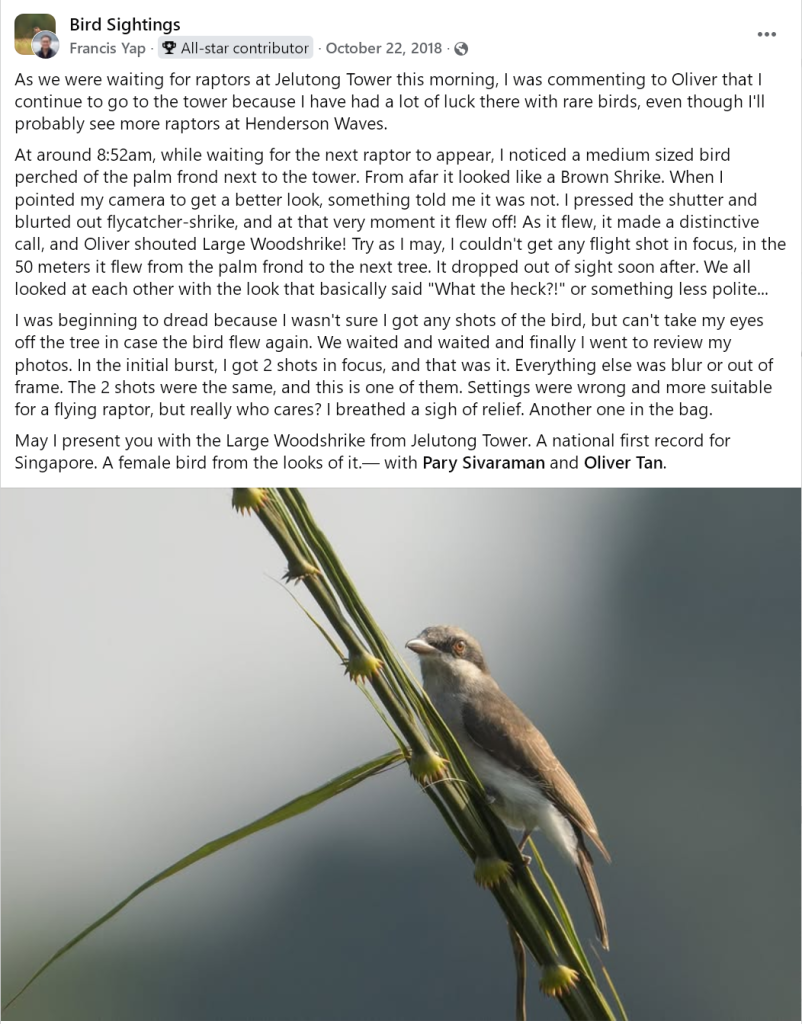
9. Large Woodshrike – Jelutong Tower (22 October 2018)
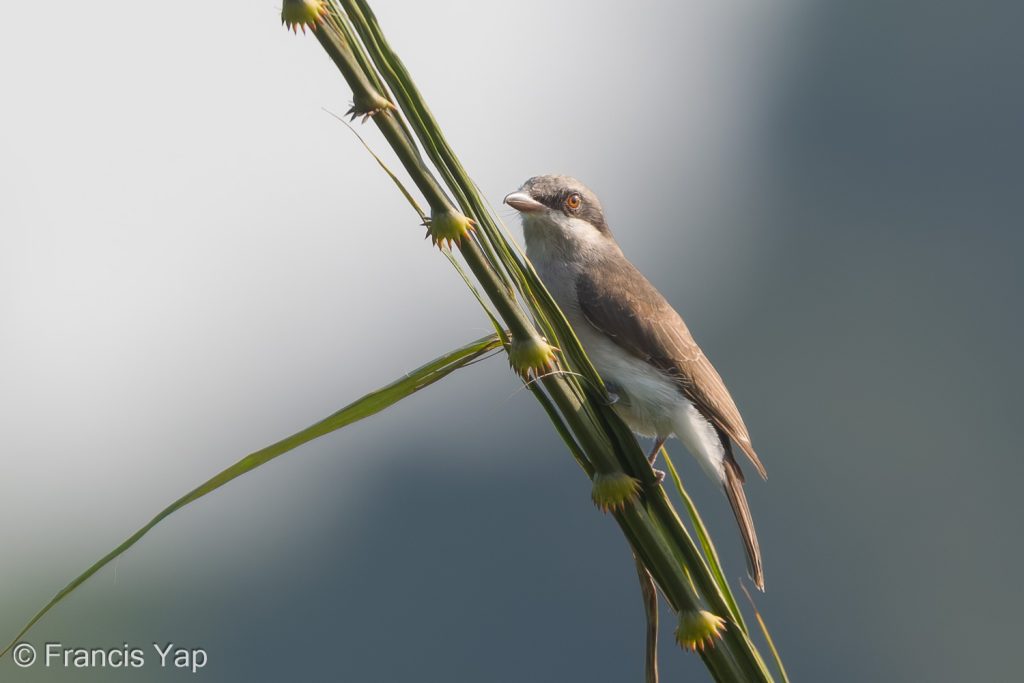
Large Woodshrike at Jelutong Tower
It was at the start of the raptor watching season in Singapore when I decided to trek to Jelutong Tower on a Monday morning. My usual birding partner Richard White was not joining, as that’s not our usual day of the week for going to the tower. At the tower, I met fellow birders Oliver Tan and Pary Sivaraman. By 8:50 am, we spotted our first raptor thermalling up in the distance. It was a honey buzzard. We were all prepared for other raptors to soon appear as the sun began to warm the forest. At 8:53 am, as we were chatting, I noticed a medium-sized bird flying in to perch on a palm frond near the tower. My first thought was that it was a Brown Shrike. I immediately repositioned myself to get a better photo angle and started to fire off a few shots, then quickly changed my mind and blurted out “Flycatcher-shrike!”. I unfortunately blocked Pary’s view with my repositioning. Before I could get more photos, the bird started flying away and made a call as it did so. Oliver, who heard the call, blurted out “Large Woodshrike!”. I could only get some out-of-focus shots of its flight before it landed on a tree about 30-50 metres away, out of our sight. A brief encounter, but we were somewhat familiar with the species, having seen them in Malaysia, so the ID was not in doubt, even at the tower. We waited quite some time for it to reappear, but evidently, it did not.
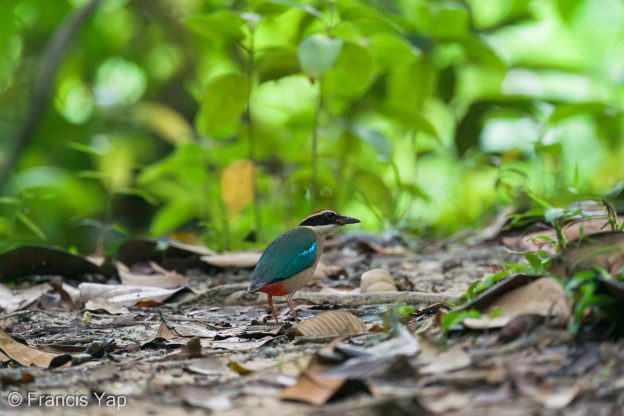
10. Fairy Pitta – Dillenia Hut (8 November 2019)
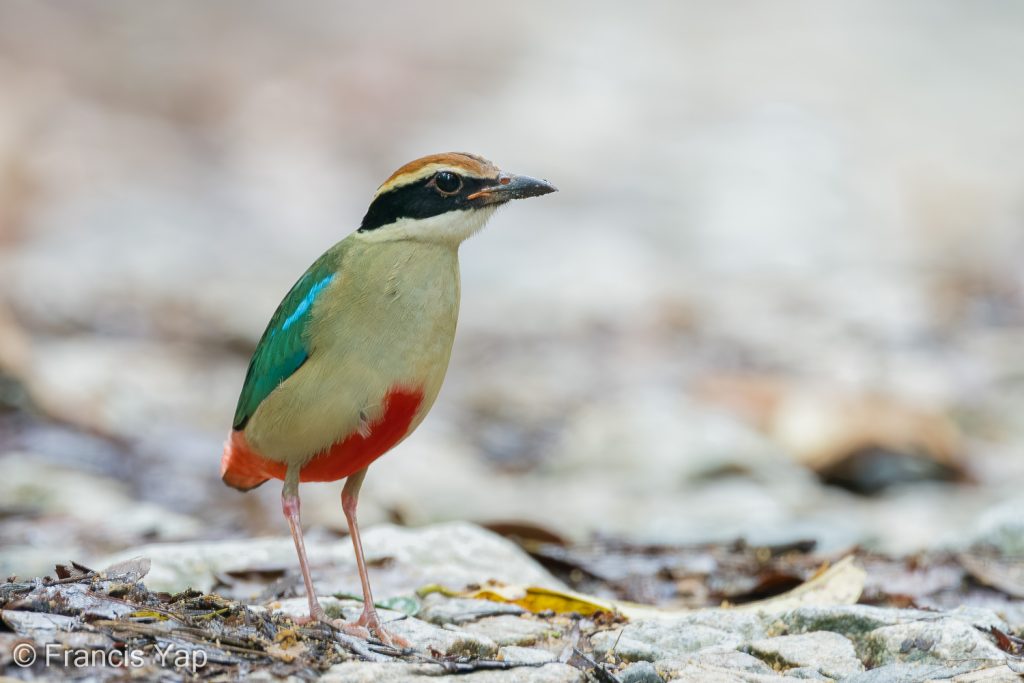
Fairy Pitta at Dillenia Hut
This is the sighting I’m most famous for. And the reason is obvious. Unlike many of the birds that I found, this one is a looker and it’s also a rather unexpected find. So the crowd that gathered after it was reported was pretty big (by pre-pandemic standards).
It was Friday, 8 November 2019, at around the peak of the migration season, when Richard White and I trekked to Jelutong Tower from the end of Rifle Range Road via the Rifle Range Link trail. It was a dark, gloomy morning. Just before 7:00 am, we crossed the lone stream and started walking towards Dillenia Hut with Richard in front. He stopped 20-30 metres in, looked through his binoculars, and told me that there was a Blue-winged Pitta in the middle of the trail. Light was very low at that moment, but I made out the shape of the pitta in my viewfinder, and it promptly hopped away! Thankfully, we quickly relocated it and I started photographing the bird. Even at 1/60s, the viewfinder and the resulting photos were pretty dark. It was 6:54 am on the EXIF data. The pitta continued slowly hopping forward towards the hut and we periodically caught glimpses of it; I felt the underparts were paler than usual, but in that lighting, it was hard to confirm. Before it jumped out of view for good very near to Dillenia Hut, I had a good glance at the upperparts of the bird again and I immediately mentioned to Richard that it was paler than the usual Blue-winged Pitta. With the lighting conditions as they were and only some quick glances and glimpses, it was hard to call it, but we were sufficiently enthused about the prospect of finding a real rarity. We decided we should immediately head towards the tower where there is phone reception, download the photo to my phone, and seek some opinions from fellow birders. By then, we were already considering the possibility of Fairy Pitta or Indian Pitta and how to differentiate these species and their respective field marks. At the tower, with better light and with access to a search engine to do some image comparison, and some quick WhatsApp message exchanges with fellow birders, we narrowed it down to Fairy Pitta. Once we were happy with that, with big smiles on our faces, we proceeded to quickly head back to Dillenia Hut. The lighting conditions improved substantially and we refound the bird and could then clearly see it was a Fairy Pitta. Without an Internet connection in the area, I resorted to old-fashioned SMS and also trekked further out, holding the phone up for marginal reception to send some WhatsApp messages to our friends. We knew we were creating history (at least from a local birding perspective) and it felt good.
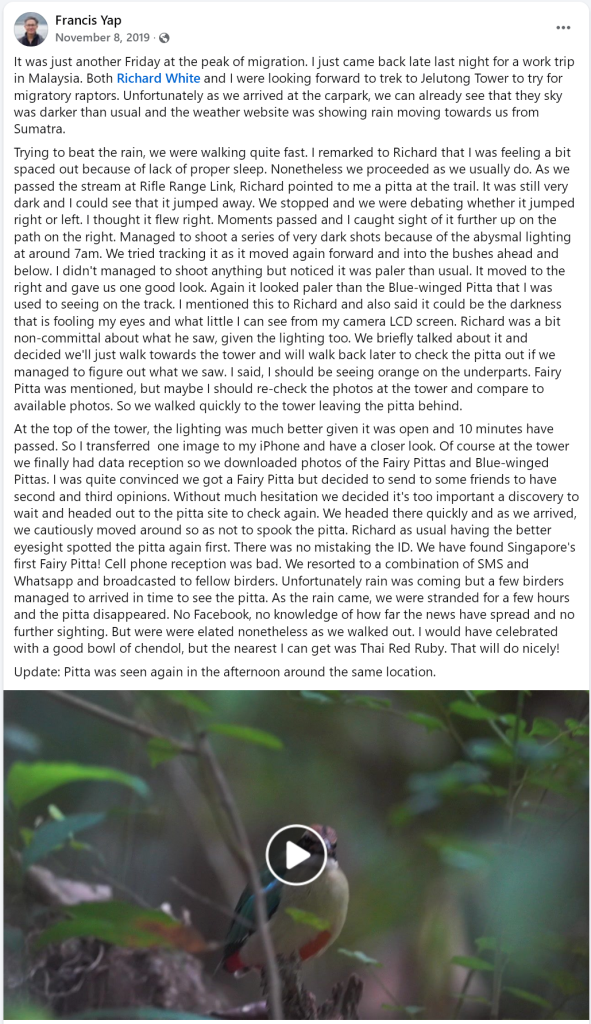
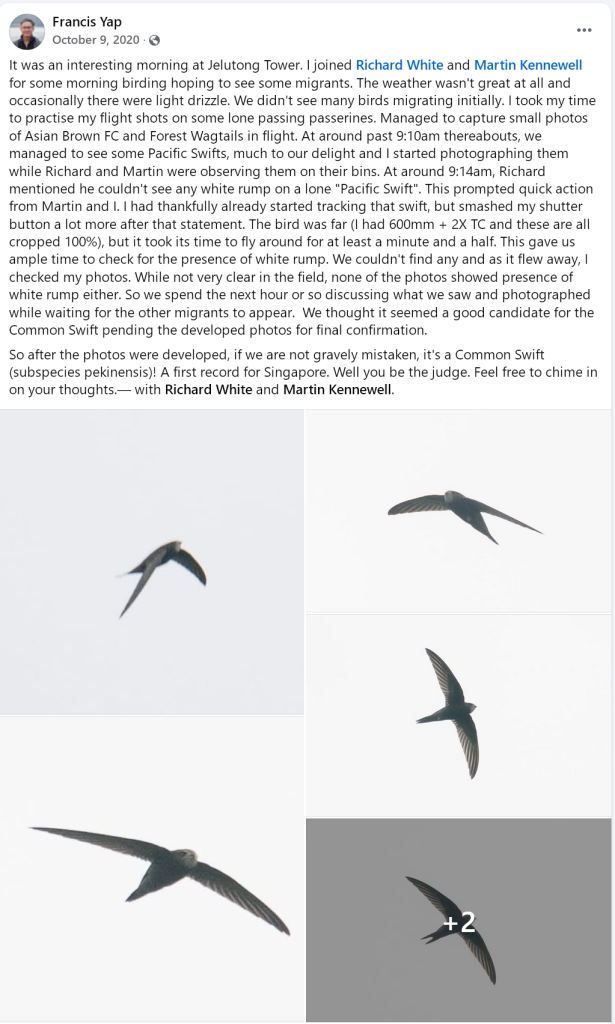
11. Common Swift – Jelutong Tower (9 October 2020)
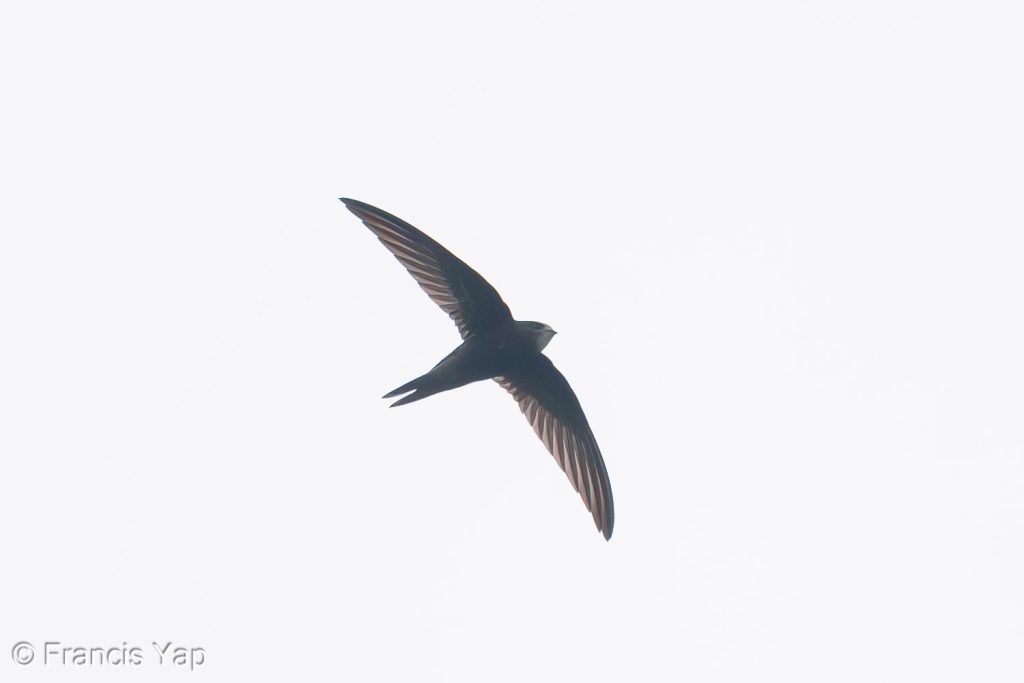
Common Swift at Jelutong Tower
Most people remember 2020 as the year of the COVID pandemic. By October, we were already seeing signs of loosening of the safety measures imposed to protect the population. However, safe distancing was still the standard operating procedure and on 9 October, with masks on, both Richard White and I travelled by car to the end of Rifle Range Rd to get to the trails with the goal of reaching Jelutong Tower. We would have arrived at the tower by around 7:30 am. At the tower, we met Martin Kennewell, who had the same idea of looking for migratory birds. Just because there was a worldwide pandemic going on didn’t mean we stopped our birding adventures, especially Martin, who was still eagerly doing his annual Big Year. The sequence of events that led to our discovery of Singapore’s first Common Swift was documented in a Facebook post that I have screenshotted below. The weather wasn’t great, being cloudy and with a slight drizzle. By 9:10 am, a few Pacific Swifts started appearing and I started photographing while Richard and Martin observed using their binoculars. I was just trying to get better photographs of Pacific Swifts rather than finding something different among them. Richard and Martin, on the other hand, were scrutinising the swifts more closely and at about 9:14 am, Richard remarked that he could not see the white rump of one of the swifts. That prompted both Martin and I to closely track that particular swift and I was tasked with trying to get as many photos of the swift as possible. I did not manage to photograph the swift with a clear angle showing the actual rump, but I had sufficient photos to show other features. As the swifts moved on, we were in deep conversation about the identity of the swift. Both Martin and Richard, who grew up in the UK, had a lot of experience in seeing and identifying this species. They discussed among themselves while I mainly listened, and they mentioned they both felt that what we saw must be a Common Swift. Having none of their experience, I could only look forward to processing the photos later when I got back. Sorting through hundreds of shots of swifts, it became clear after looking at the shots of that particular swift that we had enough details to conclude that we did indeed observe and photograph the Common Swift.
Discussion and Conclusions
Writing this post has been harder than expected. As much as possible, I wanted to look at my actual write-ups and thoughts soon after the sightings, rather than rely on present-day recollections of events that happened a long time ago. Old Facebook posts were hard to track down, things like Yahoo Groups no longer exist, and some of the earlier WhatsApp messages have also been truncated; I had previously lost about two years of actual phone content due to a careless mistake on my part. All this is to say I am very glad I managed to compile all this information and complement it with whatever I can remember now. Who knows what will happen 5–10 years down the line?
So, again, how many national firsts do I have?
I can confidently list the Black-and-white Bulbul, Large Woodshrike, Fairy Pitta, and Common Swift as uncontroversial picks. That’s four birds.
For the Shikra, I consider that Alex Fok’s sighting was what prompted the Shikra to be listed in the checklist, but I can still claim that I saw the first confirmed record. The reverse situation is the case of the Red-footed Booby, where my sighting was the reason it was included in the checklist but someone else’s bird was the actual first record. One could say in such cases, we’ll just share things and I get two ticks for these two birds, which I think is pretty fair. But my current thought is that if I want to claim the Shikra, I should not claim the Red-footed Booby and vice versa. I’m happy for Alex and Chan Yoke Meng/Melinda to claim their firsts too, mind you, but I think I shall only permit myself one tick. So plus one bird, which makes it five birds in total.
For the Sakhalin Leaf Warbler, the original finder is Lim Kim Keang, but it was my recording and my realisation about its identity that were pivotal in getting it into the checklist. In this case, I’ll claim this one. So that makes the total count six birds.
For the Lesser Black-backed Gull, it was initially included in the NSS checklist but subsequently removed due to the location. And it’s been placed in Annex A for the Bird Society’s checklist. I thought hard about it and decided that for now, I will not list this. The operative words are “for now”. It’s pretty galling that we get to count something as a national first and the accolades that come with it, and then get it wrested away a few years later. Such is birding, and a reminder that there are decisions that are beyond our control.
Like the gull, the Bulwer’s Petrel is also controversial as it’s not included in the NSS checklist due to the location where it was found, but it is included in the Bird Society of Singapore’s checklist. This may very well change in the future and revert to the same status as the gull. For now, I will put this as a tick. So that brings my count to seven birds.
For the Wilson’s Storm Petrel, the bird was too far for a good observation or photos to rule out other storm petrels, there was another prior sighting, and it’s not on the checklist. Simple decision. Not counted.
Lastly, for the Black-winged Flycatcher-shrike, I consider my sighting as the national second, so not counted.
In total, my answer in January 2026 is I have a total of seven national first birds, but with big caveats. I think it’s not too shabby.
Wonderful write up. Thanks!
Congrats Francis, that was a good read too.