The Bush Stone-curlew (Burhinus grallarius) is a endemic bird of Australia. It is rather large, ground dwelling nocturnal bird. At night it hunts for small animals and insects.
I first saw this bird at night in a beach resort on a trip to Queensland, Australia in September 2012. It stayed motionless as I neared it. A pretty eerie sight. Apparently they hunt for small animals and insects in the night.
Early next morning, a few were seen gathered next to a building and a few wandered off to the lawn of the said building. They will walk quickly, and then suddenly stop motionless. A rather peculiar behaviour.
They seem very confiding, although the fact that they were in a beach resort had something to do with it.
A close-up of it’s head. This is an uncropped picture, showing how very close I was to the bird, without it even moving a muscle.
Later in the day, they were gone. I did see one hiding in a dense bush, so their survival skill is still present.
Just a short note on this pika that I found in April 2012 at Chelela Pass, Bhutan. I believe it is the Moupin Pika (Ochotona thibetana), but I am not 100% sure.
In general, pikas are found in colder climate up in the mountains. They are related to the rabbits and hares. They look cute with rounded ears, short limbs and no external tail.
The Blue-winged Leafbird (Chloropsis cochinchinensis) is found mainly in North-East India through South East Asia. It is the commonest of the 3 species of leafbirds in Singapore. It can be found in Bukit Timah, Central Catchment Nature Reserve, Southern Ridges extending to Mount Faber and even Sentosa Island.
The male differs from the female in appearance (see pictures below). They are normally found in pairs and sometimes in a small flock. Normally, they are hard to spot unless on the move while feeding or flying to a new destination due to their green colouration.
One of the benefit of Jelutong Tower in spotting of leafbirds is that it has a good view of the surrounding forest, so the movement of leafbirds are easy to monitor. The other reason is that the leafbirds like the plants around the tower, particularly the Poikilospermum climber. It has also been seen feeding on insects.
(Front view of the male. A black face and bib, bordered by yellowish head. Notice how close in colour it is to the leaf)
(Side view of the male, showing the blue colours of the wings and tail feathers. Some field guides do not show the full extent of the blue feathers)
(The female in comparison lacks the black face and bib)
On a lunchtime break in December 2012, I decided to make a quick round to the former Bidadari Muslim cemetary, a prime birding area in Singapore. Unexpectedly, I was the lone person there. And for good reason. That day, the birds must have decided to take a break. Or perhaps they sense something else…
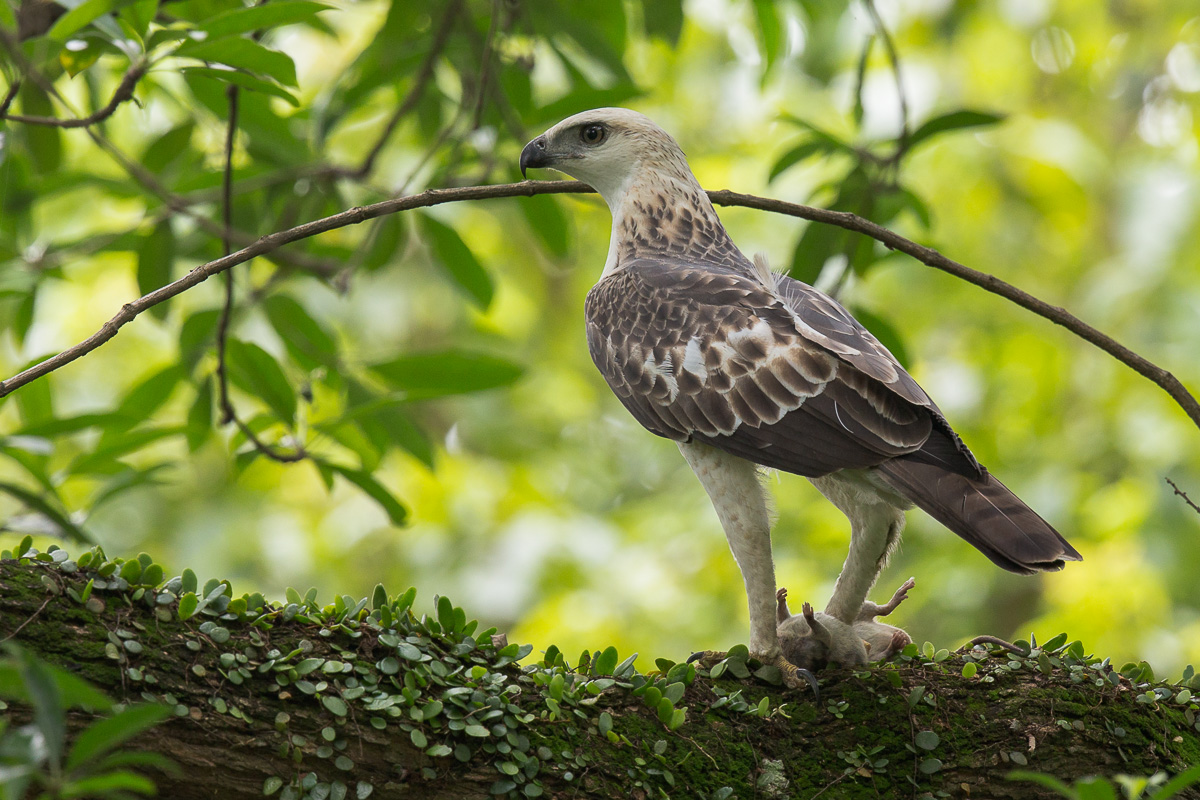
As I went along a more wooded area, and ready to leave the place, I saw movement of a large bird. Scanning the area and slowly pacing my steps, I chanced upon a raptor perched on a low branch and close by. Turned out to be a white-morph Changeable Hawk-Eagle (Nisaetus cirrhatus). Now normally if the raptor sees a person nearby it will just take-off. But it stayed, so I slowly moved my camera and lens towards my eyes. Once focused on my viewfinder, I could see that it had something on it’s leg.
It scanned around, looking warily, but never made direct eye contact. I was sure it was aware of my presence and just awaiting for the moment to get away. I rattled a few shots quickly, and the noise from the shutter of my camera made it even more nervous. I decided to continue photographing nonetheless. One does not always get a chance to photograph a raptor with a prey. Once I was satisfied with the shots from the position, I wanted a different background, so I took a step…
It then decided the that I have crossed the line and flew off for good, prey in tow. And that was the end of the encounter. No feeding shot after all.
So what was it that it was holding on to? A rat, crushed in the head by it’s powerful leg. A raptor in the city making a meal of an urbanized mammal, in a former cemetery that will soon be a fancy housing estate.
The Grey-rumped Treeswift (Hemiprocne longipennis) is one of the two species of treeswift recorded in Singapore. The other, the Whiskered Treeswift is a very rare resident that is seldom seen, with only one recent record at Upper Peirce Reservoir in 2011.
The Grey-rumped Treeswift on the other hand is a more common resident in Singapore. They can be found regularly at the Singapore Botanical Gardens, Macritchie Reservoir and recently at Bishan Park. In April/May 2011, there was a nesting record in Mandai which I had a chance to document.
Both the male and the female take turns to incubate the egg. The nest of the egg is rather small and can only fit in one adult and one egg.
The male of the species has orange red/chestnut coloured ear coverts that this female lack. Both have an attractive crest.
Early this morning, I made a walk to Jelutong Tower to meet up with a friend who came back for a short visit.
On the way to the tower, there were calls of the Brown Hawk-Owl, Short-tailed Babblers, Asian Fairy-bluebird and the Chestnut-winged Babbler. At the tower itself, there were the usual Orange-bellied Flowerpeckers, Van Hasselt’s Sunbird and the Crimson Sunbird. But the first bird that caught my photographic interest was the Banded Woodpecker (Picus miniaceus) that was calling away loudly.
(Banded Woodpecker)
Just after it flew off, a Chestnut-bellied Malkoha (Phaenicophaeus sumatranus) flew past the tower landing nearby.
(Chestnut-bellied Malkoha with an obvious chestnut-coloured belly!)
My last bird at the tower was the Square-tailed Drongo-Cuckoo (Surniculus lugubris). It was perched momentarily at an interesting branch and was calling loudly. (Square-tailed Drongo-Cuckoo with the distinctive white nape patch)
Soon it flew off, but in the process it was mobbed by bulbuls. The pattern was repeated at the next perch and the following one after that. The bulbuls really did not like the presence of the cuckoo. For good reason too. The Yellow-vented Bulbuls1 and the Olive-winged Bulbuls2 are known brood host of the Drongo-Cuckoo. To protect their own nesting, they mob the cuckoo whenever they are seen.
(Square-tailed Drongo-Cuckoo calling loudly)
After the excitement of the tower, I had a brief walk at the boardwalk. No interesting birds to report, so instead I photographed another Banded species. This time, a Banded Imperial (Eooxylides tharis distanti) butterfly.
The saltwater crocodile (Crocodylus porosus), also known as saltie, estuarine or Indo-Pacific crocodile, is the largest of all living reptiles, as well as the largest terrestrial and riparian predator in the world. The male can reach lengths of up to 7 meters and weigh as much as 2 tonnes. The female is much smaller and usually does not exceed 3 meters in length.
It is a formidable and opportunistic apex ambush predator capable of taking almost any animal that enters its territory, including fish, crustaceans, reptiles, birds and mammals, including other predators. Due to their size and distribution, saltwater crocodiles are the most dangerous extant crocodilian to humans.
The above is taken in part from Wikipedia. Sounds really dangerous. I had a few encounters with them before in Sungei Buloh and once at Kranji Bund.
This particular encounter in August 2013 was the closest. Nonetheless I kept my distance and was stationed at a bridge while the crocodile was down below with no chance of contact. All photos were taken with my 500mm lens, so the crocodile appears closer than in real life. If you do encounter a crocodile, you are ill advised to go near to take a close-up shot. They may be still or appear sedentary, but the danger is still there.
(Very still in the water, may even be mistaken for a piece of driftwood from a distance)
(In dry land, you can see the body. This one is around 3m, a small sized specimen, but still dwarfing a human nonetheless)
(A closer look at the head)
(A closer look at the tail)
(Going back to the water. Notice one of it’s tooth is stained red)
(A saltie taken at Kranji Bund in 2011. This one is nicknamed Barney. Recently deceased 1. Seen here with some foolhardy illegal anglers nearby. One of them was taking a picture of it)
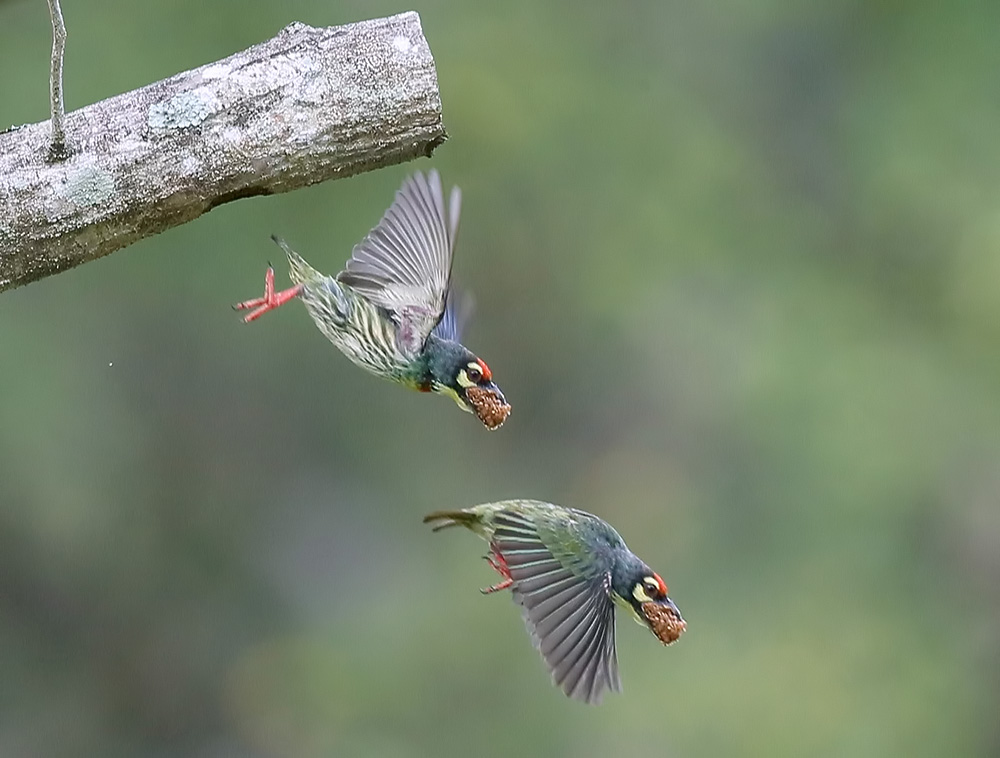
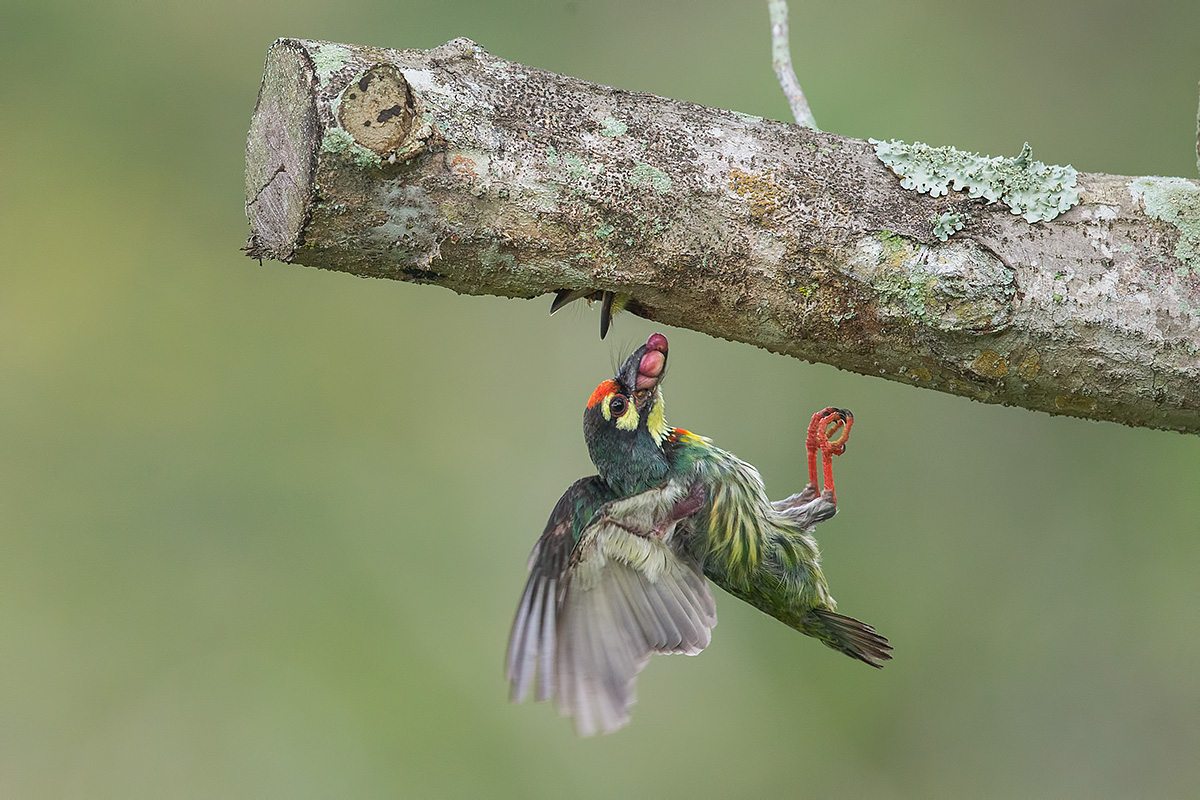
Recently there have been a lot of posts by photographer friends on a nesting of the Coppersmith Barbet. One of the most common ‘to-do’ list was to capture a parent flying in to the nest with food in mouth and with the wings spread, and the even more difficult and faster flying out with the chick’s poop in mouth! All the better with a composite shot consisting of a few wing flaps. There seem to be some competition with regards to who can capture this best, and invariably those with higher end equipment (pro vs prosumer camera, with 12 fps vs 5-6 fps), or those with the most time spent at the nest have a much better chance of success.
(composite of 2 video frames of an adult flying away from nest, processed in Photoshop)
To digress a bit, this nesting probably made history with the number of photographers present as well as actual photos taken. To estimate the actual number of photos taken is an example of Fermi problem.
From initial hole building to fledging, lets say it is 60 days
Average number of photographers present per day (higher during weekend, lower during weekday), so lets say 25 people (morning and afternoon sessions combined).
Average length of stay for photographer: 3 hours
Average feeding frequency: 15 minutes
Average number of pictures per feeding: 60
Doing the sums give you (60 X 25 X 180/15 X 60) = 1.08 million pictures!
Anyway, back to decisive moment. The reason why so many photographers go again and again to take basically the same set of pictures is because it is hard to get everything right. On a 12fps top of the range DSLR, the number of in-focus shots of the bird flying per feeding session can be as low as 2 (I will explain below with an example). For a slower frame rate camera, it is half the amount. Of these, perhaps the wing/body/eyes are in the wrong position. So it’s no wonder that people try again and again over extended period of time to get the decisive shot.
Is there a better way? Especially for those without more expensive equipment or without much time? The answer is definitely yes, and I will outline how.
To do so is to think a bit differently. Firstly, forget about shooting RAW or JPEG. Think about shooting video.
Not any video, but video at 1080p (1920 x 1080px) @30fps with ALL-I (intraframe), or 720p (1280 × 720px) @ 60fps with ALL-I (intraframe) . Most modern DSLR can do these. Make sure the settings for the shutter speed for the video is high, say 1/2000s thereabouts. Shutter speed and video fps are 2 different things. Video fps is commonly 25/30/50/60 fps for normal DSLR. Whereas shutter speed is actually how long each frame’s exposure should be. It seems funny now, but I just managed to de-couple these 2 concepts in my mind just yesterday, permitting me to test it out.
In the video below, I was shooting at 1080p @ 30fps, 700mm, f/5.6, 1/1600s, ISO 5000. The camera was pre-focussed on the tree stump via Live View, and left in manual before the video commenced. I had to settle for a slower shutter speed and higher ISO as the lighting conditions were not ideal.
The processed video has been slowed down to 10% of it’s original frame-rate. You will see that from the moment the bird start to be in focus to the time where it almost land, there are 6 separate, in-focus frames. That means the bird was in focus for 6/30 = 0.2 seconds. So if you have a top-end DSLR capable of 12fps in still shot mode, you get (12 X 0.2) = 2.4 clear shots. If your DSLR is capable of 5fps, then you get (5 X 0.2 )= 1 clear shot for this flight sequence.
So if we get 1 clear shot in still, and a video gets 6, then obviously we need to take advantage of this. But how do we get the shots out of the video? There are many ways, but I am a lazy guy. On a Mac, I just open the file in Quicktime, go to the relevant video section and advance the frame one at a time and then capture the screenshot and open in Photoshop.
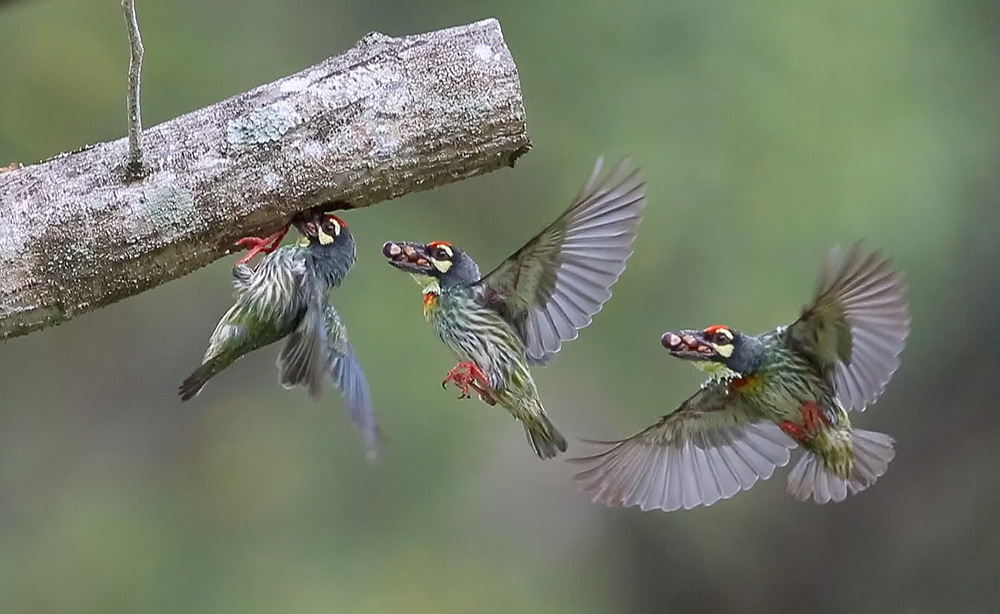
What’s the quality like? Below is a sample of the composite of 3 shots in the sequence. Cropped, resized, sharpened and some saturation added. In an ideal situation, I would prefer to frame it without cropping. In this case, I did not have a favourable position to get a closer shot, and an additional teleconverter would make the already high ISO even higher due to the dim lighting condition.
(composite of 3 video frames of an adult flight to nest, processed in Photoshop)
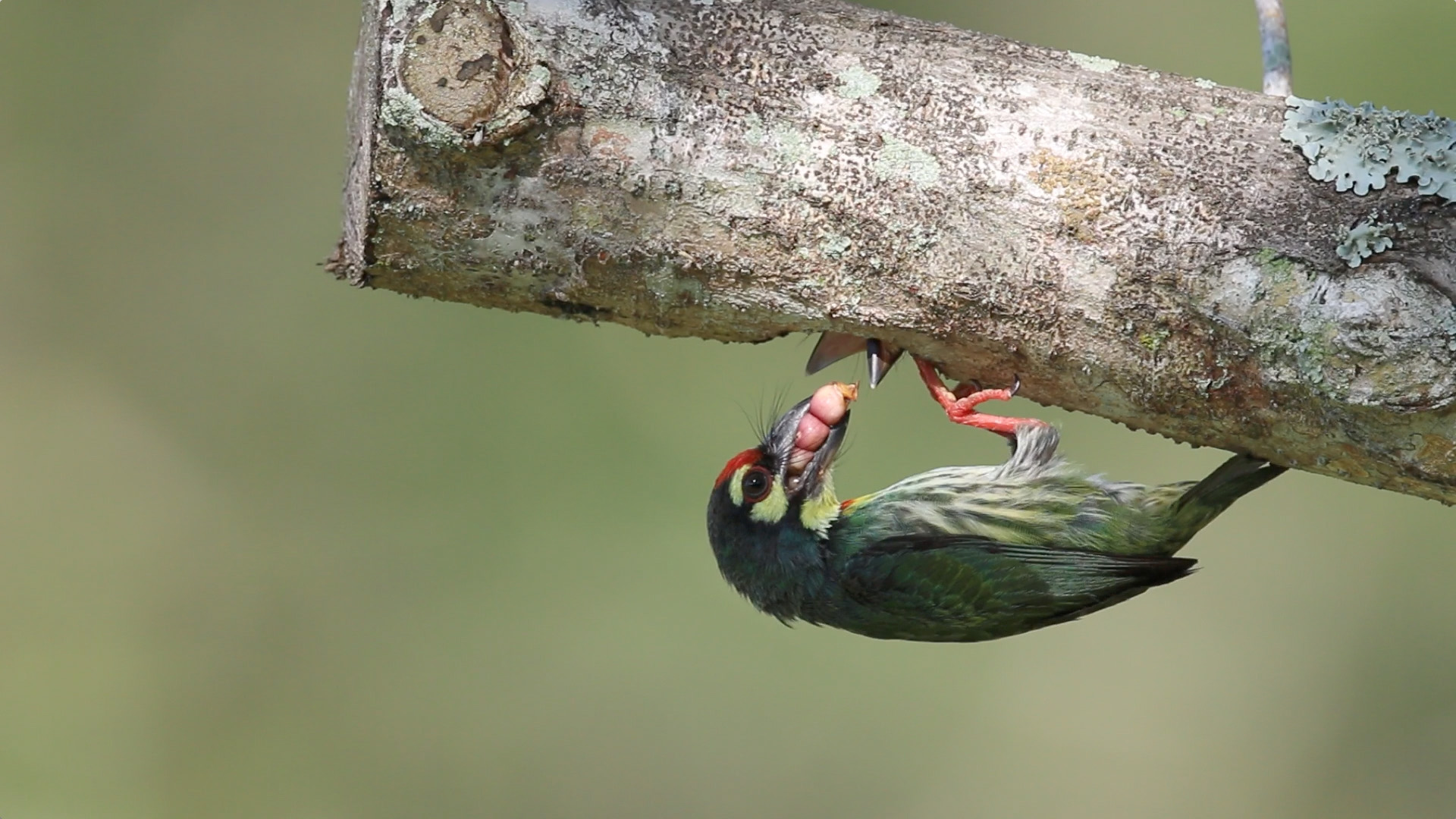
What about other scenarios? I present below a video and a screenshot of a feeding adult. This was shot using a Canon EOS70D at 1080p @ 25fp and shutter speed of 1/400s at ISO 200. I wanted a shot of the adult with full berries in mouth, with the eyes in direct line of sight and the chick head jutting out to receive. There are many frames that satisfy this criteria, but I just picked one that I like the best. Easy. There is no manipulation done. Perhaps some sharpening or cropping may be advantageous.
(photo from video frame)
To be clear, there is still a good argument to do fast-shutter speed still photography. The quality of the shots is still going to be superior. See photo below. But certainly, there are more than one way to go about doing things, and we pick and choose our tools according to the situation.
(photo developed from RAW file)
Are there any more relevant scenarios where this is useful besides nesting moments? Well, this year I wanted to photograph a snipe preening to clinch it’s ID. It took many tries using still photography, but I bet if I had used this technique instead, I would have a much better photographs to show with lesser effort. There are also many instances like a kingfisher/raptor landing/flying to/from a fixed position that will benefit from using high shutter speed video frames.
In summary, here are some of the advantages/disadvantages of this technique:
Advantages:
Judging the decisive moment is difficult in photography. You may be a bit too late/early or run out of camera buffer. You may have low fps camera. In this technique, just start video before the subject’s arrival and wait. While others are fretting about buffers and timing, sit back and relax.
You have many frames to choose from per session. Up to 6 times more than a slower camera, so choose the best post/moments. If that is not sufficient, then use 720p @ 60fps, You get a smaller dimensioned files, but twice as many frames than 1080p @ 30fps.
Certain micro details are only visible in video. No matter how skillful you are, an owl swaying side to side for example is difficult to show in still picture. This is just the result of the strength of the medium. In this barbet feeding session, you get to learn more about the bird. How fast it flaps its wings, or even how it angled its flight for example. I think the ability to slow things down makes the whole viewing experience more enjoyable, and video frames is superior to still frames in that regard.
You spend less time on one bird, or one one aspect of the bird and more time on other things. That’s always good for yourself and for the bird.
Disadvantages:
Only applicable to fixed focus subject.
Limited to certain sizes of picture. This will change in future as 4K video capable camera are more reasonably priced. For now, it’s Facebook sized pictures
Frames out of the video is not as good in quality compared to RAW files, due to the nature of video compression
Takes the fun out of the excitement of waiting. Like the initial introduction of autofocus, some purist will say this is the death knell for the art of photography or of the decisive moment.
Disclaimer: This is a rough guide, not a step by step guide. I do not guarantee that what works for me will work for everyone else. Every camera system is different with a multitude of settings. Please experiment and find your ideal settings.
The Green Crested Lizard (Bronchocela cristatella) is a lizard found in South East Asia.
It is bright green in colour, sometimes with a bluish tint in the head area. When threatened, it can turn brownish in colour. The male has a neck crest. It has a very long tail that makes up over 75 percent of its total length.
In Singapore, it is in decline due to competition with the introduced Changeable Lizard (Calotes versicolor).
(Male Green Crested Lizard at Sungei Buloh)
This picture was taken at the mangroves of Sungei Buloh in August 2012. The tail was a bit too long to fit nicely in the composition.
Here I will like to share some pictures and videos of my encounters with the Western Barn Owls in Singapore as well as other information regarding the species.
The Barn Owl is the most widely distributed species of owl, and one of the most widespread of all birds as it is present in very continent except Antartica. It has a pure white almost angelic or ghostlike face. Its pale, white, heart-shaped face looks striking with black eyes. The barn owl’s bill and mouth are covered by a hood of white feathers. Its head is rust coloured with its back and wings ranging from tan to brown accented by patterned gray wing tips. The belly is a pale tan or white. Females are slightly longer and heavier than males.
(A Western Barn Owl at Marina Barrage, January 2011)
Like most owls, they have exceptional low-light vision. However it is noted that their eyes are relatively small compared to other owls. This is because an exceptional hearing ability is their most advantageous hunting feature. Barn Owls have asymmetrical ears; one is found higher on the head and points up, while the other is more level with their nostrils and point down. They are covered with feathered flaps that close for loud noises and open for soft sounds. The heart-shaped face also collects sound in the same way as human ears. Its hearing is reputed to be the most sensitive of any creature tested. It is so sharp that it can easily hunt for rodents, which are often concealed from view as they travel in runways beneath the grass.
Another attribute that assists the owl’s hunting is their wings. The feathers on the owls wings are not waterproof, so they are more closely related to down than the average bird feather. This unique feature allows them to fly in complete silence.
The Barn Owls monogamous and mates for life. They are not aggressive toward other barn owls and can nest nearby other pairs. They do not construct a nest; the eggs are laid in a dark space surrounded by pellets. These brownish-black pellets, which are the regurgitated fur and bone fragments of each meal, average about 2 inches in size and are produced twice a day. The female lays between 5-11 eggs (average 4-6), which are laid every other day, which upon hatching will be fed by the adult male for up to two months. Hatching occurs in the same order as the eggs were laid. In times of scarce food, the older and stronger hatchling have a better chance of survival.
In Singapore, the species of barn owl we have is called the Western Barn Owl (Tyto alba). Since Singapore is an urban environment, they are more easily found in places like abandoned buildings and other man-made structure. Though uncommon, from time to time, random owls have been reported by member of the public in unexpected places, including MRT and LRT stations1.
(Screenshot taken off Facebook)
The most famous recent Barn Owl encounter was when a lone owl flew into the Prime Minister’s office, the Istana in November 20132. A resulting Facebook posting gathered more than 27,000 ‘Likes’ and around 1,800 ‘Shares. That is considerably higher than other more weighty issues of the day that was posted before and after the incident.
(A pair of Western Barn Owl photographed in the night without flash)
In another man-made structure nearby, I had a recent encounter with these birds with my family. This is a known rooting place of the owls, therefore the location is not publicly shared. This is to protect this species from harm. A total of 3 birds turned out that day to greet my family. The picture shows what is probably a pair of adults looking down curiously at the human below, with the juvenile further away.
No flash were used, just a LED powered torchlight. They appeared without sound, although their calls were really screechy. No hoots as commonly presumed. Other sightings in the same location have count of up to 4 birds.
(A daytime Western Barn Owl at Tuas South, November 2013)
Although the barn owls are found mainly in man-made structure in Singapore and more easily seen at night, I have encountered them before in grassland area at Tuas South in day time. While observing migrating raptors, a Barn Owl suddenly came by and flew into nearby trees. Its presence in the day is not common, but the grassland does serve as a hunting ground for rodents, which is their main diet. It flew away soon after to a nearby fenced-up grass patch.
(A Western Barn Owl at Marina Barrage, seen sleeping in the daytime)
Perhaps the closest and longest encounter I had with this species is at Marina Barrage in January 2011. A lone owl was roosting just above where people gathered and children played. Most were unaware of its presence. In the day time, it was mainly sleeping, although in moments of wakefulness, it exhibited various owl behaviour that I managed to document through video.
Eyes closed, mouth looking as if munching and the face expression is one of contentment and bliss. Perhaps a dream or maybe too much anthropomorphism!
The owl is seen swaying from side to side. This is a common behaviour of the Barn Owl.
A few things to notice. Barn Owls preen a lot in the day time in between sleeping. It also is seen resting solely on one foot. Yet another common behaviour of the owl. Lastly, notice that the owl really can twist it’s head almost 180 degrees to reach it’s back.