The White-rumped Shama (Copsychus malabaricus) is a songbird that is native to South Asia and South-east Asia. It has a rich and highly melodious voice which unfortunately made it one of the most popular cagebirds in its native territory. Due to this fact, it has been poached to near local extinction in the mainland of Singapore. However it is still found in good numbers in the offshore island of Pulau Ubin and Pulau Tekong.
The male and the female bird differ in appearance, with the male being more striking with its very long tail, glossy blue-black on the head, breast and upperparts. The underparts is deep rufous-orange. In comparison, the female has a dark grey (not glossy) parts at the same location and the underparts a duller rufous colour.
Because they have a very melodious voice, locating them by the song they make is much easier than sighting them, as they tend to be rather shy and skulking in behaviour. If they are not singing, they oftentimes call with a harsh ‘tschak’ while foraging or alarmed that is also indicative of their presence.
The best place to find them in Singapore is currently Pulau Ubin where a morning walk from the jetty to Chek Jawa will invariable reveal 3-4 of them if one knows what to look out for. In the mainland, it is much harder to find them. They are still present and breeding, and have been found in various locality like Central Catchment Nature Reserve and Bukit Timah Nature Reserve. Due to the ongoing poaching activities, exact locality cannot be provided.
Photo Gallery
-
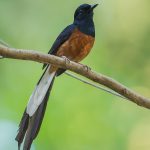
- The male with the glossy blue-black upperparts, head and breast. The tail in this specimen seem to be cut off. This was taken at Pulau Ubin
-
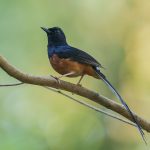
- A slight hint of the white rump, from which their species English name is derived. The Malay call this bird either Burung Murai Batu or Burung Murai Rimba.
-
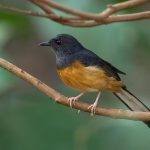
- The female in comparison to the male has a dark grey head, breast and upperparts. The underparts is also less deeply rufous
-
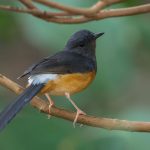
- The female showing its prominent white rump. This bird was seen at Chek Jawa Wetlands at Pulau Ubin.
-
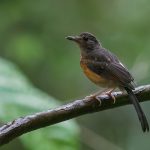
- The juvenile looks more like the female, but its upperparts and head are browner and with buff speckles. It has also a more prominent gape. This individual was seen at the Central Catchment Nature Reserve, in July 2014 indicating that breeding is still occurring in the mainland. As with most juveniles, it was more confiding than the adults.